Wallets




Frequently Asked Questions about Wallets & Security
What do I need for secure Bitcoin self-custody?
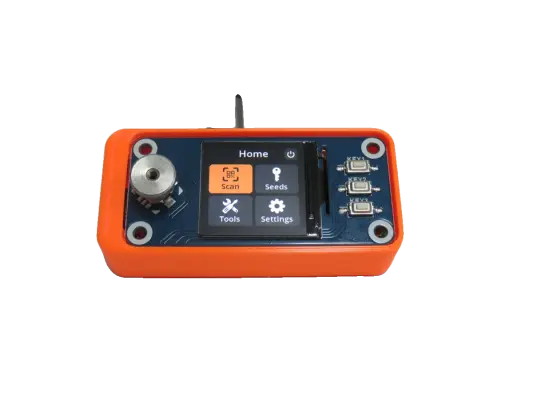
Two things are essential: a hardware wallet that keeps your private keys offline, and a metal seed backup that lets you restore everything if the device is lost. From there you can build up as far as you like: your own Bitcoin node makes verification independent of third-party servers, a security key protects the accounts around your coins (exchange, email) against phishing, and the SeedSigner is the open-source path to a self-built signing device. Each layer works on its own — wallet plus backup is the place to start.
Is a hardware wallet a USB stick with my Bitcoin on it?
No — that picture is misleading. Bitcoin always lives on the blockchain; the hardware wallet only stores the private keys you control it with, and signs transactions without the keys ever leaving the device. That's also why your coins aren't lost when the device breaks: with the 12- or 24-word recovery phrase you restore access on any new device. The device is the key to the vault — not the vault itself.
Hardware wallet or paper wallet — what's the standard today?
The paper wallet — a printed-out private key — is considered obsolete: it has to be generated on an online device, spending from it is error-prone, and paper survives neither fire nor water. Today's standard is a hardware wallet with a BIP39 recovery phrase, secured on a metal plate. That keeps the key permanently offline, transactions are verified on the device, and the backup survives even a house fire — more on that in the Backups category.
Which device is right for getting started?
Three questions lead to the answer: Do you hold only Bitcoin or other coins too? Do you want to work at the computer, on your smartphone, or fully air-gapped via QR codes? And how much does open-source firmware matter to you? We carry devices from BitBox, Trezor, Ledger, Blockstream, Foundation, Keystone, OneKey and ELLIPAL — from compact entry models to touchscreen devices. The detailed buying guidance with all the differences lives in the Hardware Wallets category; tinkerers build their own signing device with the SeedSigner.
Why does every wallet need a metal backup?
Because the recovery phrase is the actual backup of your wallet — the device can be replaced, the words cannot. Paper burns, soaks and fades; stainless steel and titanium survive a house fire with a wide margin. In the Backups category you'll find stamping and capsule systems from Stamp Seed, Cryptosteel, Cryptotag and SEEDOR for 12 and 24 words — along with answers to every question about materials, system choice and storage.
What do a node and a security key add?
Both close gaps the wallet alone doesn't cover. Your own Bitcoin node verifies transactions itself and answers your wallet's balance queries without any third-party server seeing your addresses — verification and privacy in one. A FIDO2 security key protects the accounts around your Bitcoin — exchange, email, cloud — with phishing-resistant login; your email inbox in particular is the master key to almost everything else. Wallet, backup, node and key together form the complete security stack.